
How to calm your nervous system, fast and before bed
Some days you need calm in the next two minutes. Other nights you need your body to land so you can sleep. Here are the breathing tools I use for both, and the science behind why a long exhale helps.

The short answer. To calm your nervous system fast, take two or three physiological sighs or breathe in for four and out for eight for a minute or two. Before bed, give yourself a 20 minute wind-down: dim light, no phone and about 10 minutes of slow breathing near six breaths a minute. Long, slow exhales are linked with greater parasympathetic, rest and digest activity.
Why calm starts with your exhale
Every breath you take nudges your heart. As you inhale, your heart rate rises a little. As you exhale, it eases back down. This rhythm is normal and healthy, and it is one reason breathing is such a direct line into your nervous system (Russo et al., 2017).
When you make the exhale longer and slower, you spend more of each breath in that easing-down phase. Reviews of the research link slow breathing with greater parasympathetic activity, more alpha brain waves and lower arousal, along with people reporting feeling more relaxed (Zaccaro et al., 2018). That is the whole idea behind everything below. You cannot think your way calm, but you can breathe your way toward it.
How to calm your nervous system fast: 3 tools under 2 minutes
Use these in the moment: before a hard conversation, after a near miss in traffic, when your inbox spikes your heart rate. Pick one and do it for one to two minutes.
- The physiological sigh. Breathe in through your nose, then sip in a little more air on top. Let it all out in a long, slow exhale through your mouth. Repeat two or three times, then breathe normally. In a Stanford study comparing breathing practices with mindfulness meditation, five minutes a day of this cyclic sighing gave the biggest boost in mood (Balban et al., 2023). My guide to the physiological sigh goes deeper, and why we sigh explains why your body does this on its own.
- The long exhale. In through your nose for four, out for eight. If eight feels like a stretch, start with six. Let your shoulders drop on every exhale. Ten rounds takes about two minutes.
- Box breathing. In for four, hold for four, out for four, hold for four. The steady count gives a busy mind something to hold on to, which is why so many people under pressure like it. If the holds make you anxious, skip them and use the long exhale instead.
None of these is magic. They work best when you have practiced them on calm days, so your body already knows the pattern when stress hits.
How to activate your parasympathetic nervous system
Your parasympathetic nervous system is the rest and digest side. The most reliable way I know to invite it in is slow breathing at around six breaths a minute, which is roughly in for four or five seconds and out for five or six. A 2022 meta-analysis found that voluntary slow breathing raises heart rate variability, a common marker of parasympathetic activity, while people practice (Laborde et al., 2022). Breathing near this pace is also the basis of heart rate variability biofeedback, which researchers think works partly through the body's blood pressure reflexes (Lehrer and Gevirtz, 2014).
Researchers have also proposed that long exhales are one of the main ways breathing engages the vagus nerve, the main pathway of the parasympathetic system (Gerritsen and Band, 2018). You do not need to count perfectly. Slow, smooth and a little longer on the way out is enough.
How to calm your nervous system before bed
Most of my students who sleep badly are not short on tiredness. They are short on a runway. They go from bright screens and busy thoughts straight to the pillow and expect their body to land. Give yourself the last 20 minutes of the day as a wind-down instead.
- Dim the lights and put the phone away. Screens keep you scanning, and reading on a phone may quietly reduce how often you sigh. I wrote about that in why we sigh and how screen time cuts your sighs.
- Lie down and take three physiological sighs. Let each long exhale soften your jaw, shoulders and belly.
- Breathe slowly for 10 minutes. Aim for about six breaths a minute, in for four, out for six. In a 30-day study, people who did slow-paced breathing for 15 minutes before bed reported better sleep quality than people who used social media instead (Laborde et al., 2019). Some people like 4-7-8 breathing here. There is little research on that exact count, but it shares the long exhale that the better-studied methods have in common.
- Let go of the breath. Stop counting. Let your breath be louder than your thoughts and let it find its own pace. Notice your heartbeat and the weight of your body on the bed. If you fall asleep here, that is the point.
Follow along with my guided sessions
My 12 minute nervous system reset ends with a long guided rest. It starts with five minutes of power breathing, which is energizing, so use the whole session in the late afternoon or early evening. At bedtime, skip ahead to the rest at 8:18 (start the rest here) and let it carry you down.
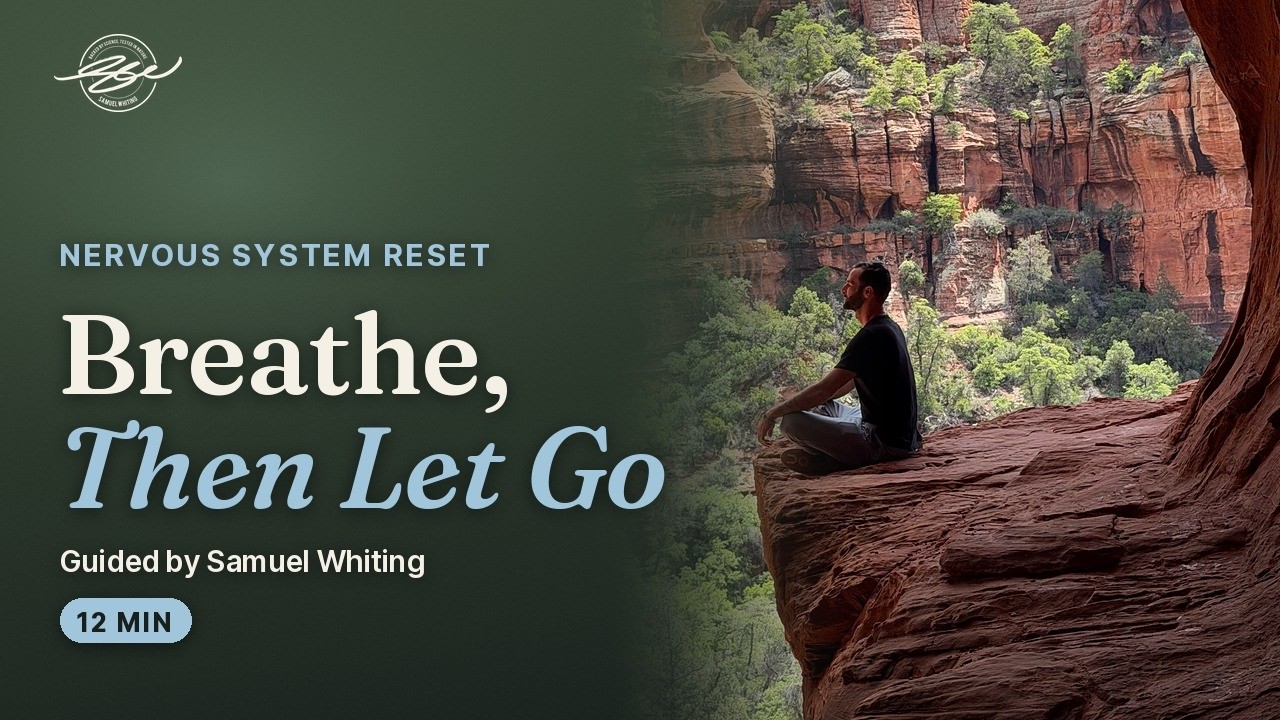
Nervous system reset breathwork
Five minutes of two-part power breathing lying down, then a deep rest where you let go of conscious breathing and settle.
Calm at night starts with energy in the morning. A clear start gives your body a rhythm to come down from later. This is my 10 minute morning session.

10 minute morning breathwork for energy
Long candle-flicker exhales, bellows breath with cat and cow, and 100 exhale pulsations to wake up your breathing muscles.
Make calm a skill, not a rescue
A 2023 meta-analysis of randomized trials found breathwork was associated with lower self-reported stress, with small to moderate effects (Fincham et al., 2023). Small effects add up when you practice daily. Five minutes in the morning and the wind-down at night will do more than a perfect technique you only reach for in a crisis.
If you want the bigger picture, read my breathwork guide, try the five minute daily regulation routine, or follow the five steps in how to reset your nervous system.
When calm will not come
This article is education, not medical advice. Breathing is a helpful daily tool, but it is not a treatment for anxiety, panic, insomnia or any medical condition. If you often feel wired at night, wake with a racing heart, or your stress gets in the way of your life, please talk to your clinician or a qualified mental health professional. Never practice breathwork in or near water or while driving. If you are pregnant or have a heart condition, high blood pressure or epilepsy, keep to slow, gentle breathing and check with your clinician first.
Questions people ask me
How can I calm my nervous system fast?
Try two or three physiological sighs, a double inhale through the nose followed by a long exhale through the mouth, then a minute of breathing in for four and out for eight. Long, slow exhales are linked with greater parasympathetic activity, so many people feel calmer within a few breaths.
What is the fastest way to activate the parasympathetic nervous system?
Slow breathing with a longer exhale, around six breaths a minute, is one of the simplest ways to invite it in. A 2022 meta-analysis found that slow breathing raises heart rate variability, a common marker of parasympathetic activity, while people practice.
What breathing helps you fall asleep?
Slow, gentle breathing with a longer exhale, done lying down for about 10 minutes before sleep. In a 30-day study, people who did 15 minutes of slow-paced breathing before bed reported better sleep quality than those who used social media instead.
Does 4-7-8 breathing work?
There is little research on the 4-7-8 count itself. What it shares with better-studied methods is a long, slow exhale, which research links with a calmer state. If the hold feels uncomfortable, breathe in for four and out for six or eight instead.
Why do I feel wired at night?
Many things can play a part, including bright screens, late stress, caffeine and an irregular schedule. A 20 minute wind-down with dim light, no phone and slow breathing gives your body a runway. If it keeps happening, talk to your clinician, because breathing is not a treatment for insomnia or anxiety.
Let me guide your wind-down
The free Starter is a 10-minute guided breathing session and a seven-day guide. It is a gentle place to start.
References
- Balban et al. (2023). Brief structured respiration practices enhance mood and reduce physiological arousal. Cell Reports Medicine. doi.org/10.1016/j.xcrm.2022.100895
- Russo et al. (2017). The physiological effects of slow breathing in the healthy human. Breathe. doi.org/10.1183/20734735.009817
- Zaccaro et al. (2018). How Breath-Control Can Change Your Life: A Systematic Review on Psycho-Physiological Correlates of Slow Breathing. Frontiers in Human Neuroscience. doi.org/10.3389/fnhum.2018.00353
- Laborde et al. (2022). Effects of voluntary slow breathing on heart rate and heart rate variability: A systematic review and a meta-analysis. Neuroscience and Biobehavioral Reviews. doi.org/10.1016/j.neubiorev.2022.104711
- Lehrer and Gevirtz (2014). Heart rate variability biofeedback: how and why does it work? Frontiers in Psychology. doi.org/10.3389/fpsyg.2014.00756
- Gerritsen and Band (2018). Breath of Life: The Respiratory Vagal Stimulation Model of Contemplative Activity. Frontiers in Human Neuroscience. doi.org/10.3389/fnhum.2018.00397
- Laborde et al. (2019). Influence of a 30-Day Slow-Paced Breathing Intervention Compared to Social Media Use on Subjective Sleep Quality and Cardiac Vagal Activity. Journal of Clinical Medicine. doi.org/10.3390/jcm8020193
- Fincham et al. (2023). Effect of breathwork on stress and mental health: A meta-analysis of randomised-controlled trials. Scientific Reports. doi.org/10.1038/s41598-022-27247-y