
How to reset your nervous system: five breath-led steps
When stress keeps you stuck in high gear, you cannot think your way out of it, but you can breathe your way toward a reset. Here are the five steps I teach, from a two-minute version to a full 12 minute guided rest.

The short answer. To reset your nervous system, pause and orient, make your exhale longer than your inhale, take two or three physiological sighs, move your body, then rest deeply for 10 minutes. Research suggests slow breathing with long exhales may help shift you toward the parasympathetic, rest and recover state. Practice a few minutes daily so the skill is there when you need it.
What a nervous system reset really means
There is no off switch for stress, and you do not need one. Your autonomic nervous system is always adjusting: the sympathetic side gears you up to meet a challenge, and the parasympathetic side helps you rest, digest and recover. Trouble starts when you get stuck in one gear. You finish the day and your jaw is still tight, your breath is still high in your chest and your mind is still running laps.
When I talk about a reset, I mean helping your body shift gears on purpose. Not forcing calm, and not pretending the stress is not there. Just giving your system a clear signal that the moment has passed. Breath is my favorite tool for that because it is the one part of this automatic system you can steer directly, and you can feel it working within a few breaths.
I have taught this to elite athletes, executives and people who simply could not switch off at night. The steps below are the same ones I use myself.
Signs you might be stuck in a gear
These are common patterns people describe to me. They are not a diagnosis, and they can have many causes, so check in with your clinician if any of them last.
- You feel wired and tired at the same time.
- Your breathing is fast, shallow or mostly in your upper chest.
- You clench your jaw, shoulders or hands without noticing.
- Small things startle or irritate you more than usual.
- You struggle to wind down, even when you finally have time to rest.
How to reset your nervous system in 5 steps
Do them in order the first few times. Once you know them, pick the one that fits the moment. The whole sequence takes about 15 to 20 minutes, and the first three steps fit into two minutes when that is all you have.
- Pause and look around. Stop what you are doing. Let your eyes move slowly around the room or the horizon and name three things you can see. Feel your feet on the floor. This simple orienting tells your body where you are, and it gives you a moment to notice how you are breathing before you change anything.
- Make your exhale longer than your inhale. Breathe in through your nose for a count of four, then out through your nose or soft lips for six to eight. Keep it gentle, with no strain. Do this for two to five minutes. Slow breathing with a longer exhale is linked with greater parasympathetic activity and a calmer state in research reviews (Russo et al., 2017; Zaccaro et al., 2018), and slow breathing tends to raise heart rate variability while you practice (Laborde et al., 2022).
- Take two or three physiological sighs. Inhale through your nose, then sip in a little more air on top. Let it all go in a long, slow exhale through your mouth. In a Stanford study, five minutes a day of this cyclic sighing was linked with better mood and a lower resting breathing rate after a month (Balban et al., 2023). I wrote a full guide to the physiological sigh if you want the details.
- Move, then get outside if you can. Shake out your arms and legs for 30 seconds, roll your shoulders, take a slow walk. Stress hormones prepare you to move, and gentle movement gives that energy somewhere to go. If you can step outside, do it. In one study of city dwellers, 20 to 30 minutes in a nature spot of their choice gave the most efficient drop in the stress hormone cortisol (Hunter et al., 2019). Some people also like splashing cool water on the face. If cold is part of your practice, start with my cold and heat guide.
- Rest deeply for 10 minutes. Lie down, let go of controlling your breath and let your whole body settle. This is where the reset lands. The easiest way to do it is to follow along with my free 12 minute session below.
Follow along: my 12 minute nervous system reset
This is the session I made for step 5. It starts with five minutes of two-part power breathing lying down, then guides you into deep rest where you stop doing anything at all. The active breathing intentionally gears you up first. Research on trained breathing techniques shows people can voluntarily activate the sympathetic nervous system (Kox et al., 2014), and many of my students find the rest afterwards feels deeper because of that contrast.
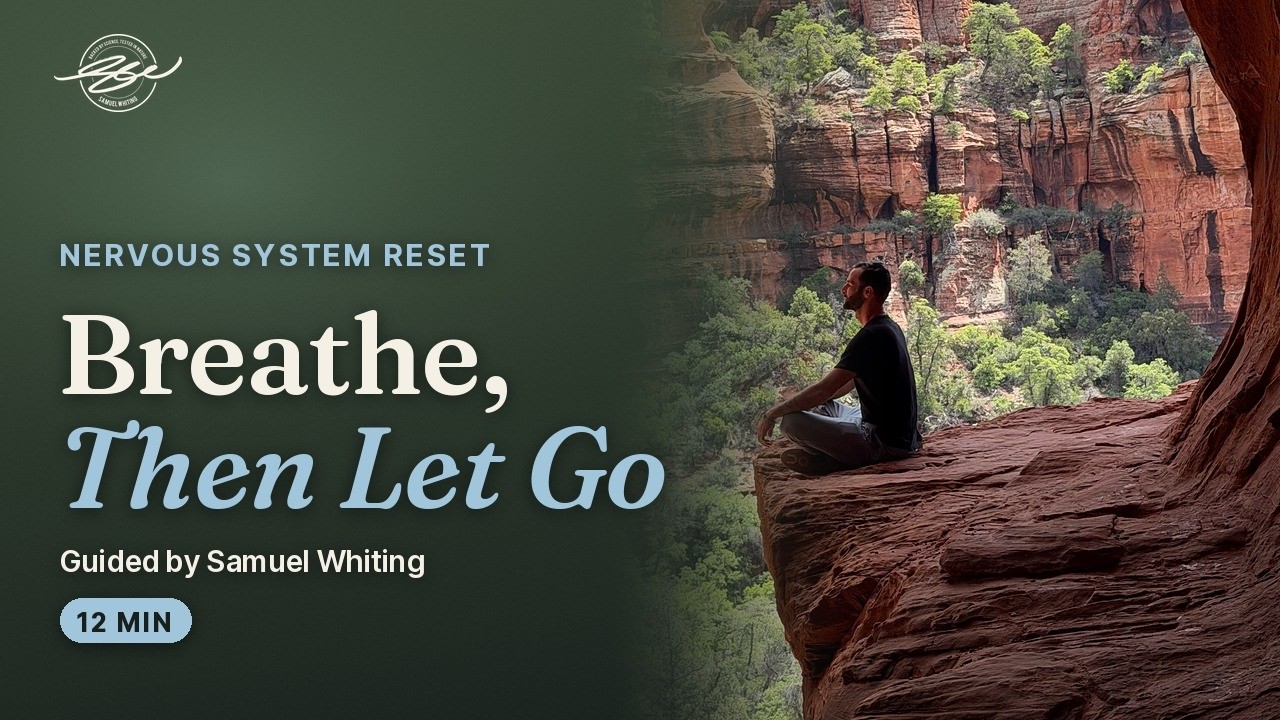
Nervous system reset breathwork
Five minutes of two-part power breathing lying down, then a deep rest where you let go of conscious breathing and settle. A good one for the end of a long day.
Where the vagus nerve fits
You will see a lot of talk online about a "vagus nerve reset." The vagus nerve is a major pathway of the parasympathetic nervous system, connecting your brainstem with your heart, lungs and gut. Researchers have proposed that slow breathing with long exhales is one of the main ways contemplative practices engage it (Gerritsen and Band, 2018).
So when people say they are resetting the vagus nerve with breathing, they are usually describing steps 2 and 3 above. You do not need special gadgets or extreme methods. Slow, long exhales, practiced often, are the foundation.
A 2 minute reset and a daily practice
In a hard moment, use the short version: pause and look around, take three physiological sighs, then ten slow breaths with a longer exhale. That is about two minutes, and you can do it at your desk, in the car before you walk inside, or in a bathroom stall before a big meeting.
The bigger shift comes from practicing when you do not need it. A 2023 meta-analysis of randomized trials found breathwork was associated with lower self-reported stress, with small to moderate effects (Fincham et al., 2023). I think of it like training. Five minutes a day builds the skill so it is there when life gets loud. My daily breathing practice for nervous system regulation walks you through a five minute routine.
And sometimes a reset means waking up, not winding down. If you feel flat and foggy, try my morning session instead.

10 minute morning breathwork for energy
My Breath Workout of the Day. Long candle-flicker exhales, bellows breath with cat and cow, and 100 exhale pulsations to wake up your breathing muscles. Sit down, press play and start your day.
Practice safely
This article is education, not medical advice. Breathing practices are not a treatment for anxiety, panic, trauma or any medical condition. Never practice breathwork in or near water, while driving or standing where a fall could hurt you. If you are pregnant or have a heart condition, high blood pressure, epilepsy or a history of panic attacks, talk to your clinician first and keep to slow, gentle breathing. If you are struggling, please reach out to a qualified professional.
Questions people ask me
How do I reset my nervous system fast?
Pause and look around for a moment, take two or three physiological sighs (a double inhale through the nose and a long exhale through the mouth), then take ten slow breaths with an exhale longer than the inhale. It takes about two minutes. Long, slow exhales are linked with greater parasympathetic activity, which is why many people feel calmer within a few breaths.
How long does it take to reset your nervous system?
Many people notice a shift within a few minutes of slow breathing. A fuller reset, with breathing, movement and 10 minutes of deep rest, takes about 15 to 20 minutes. The bigger benefit tends to come from practicing a few minutes every day so the skill is there when you need it.
Can breathing really reset your nervous system?
Breathing cannot switch stress off, but research suggests it may help you shift state. Reviews link slow breathing with greater parasympathetic activity, and a 2023 meta-analysis of randomized trials found breathwork was associated with lower self-reported stress, with small to moderate effects.
What is a vagus nerve reset?
It is a popular name for practices thought to engage the vagus nerve, a main pathway of the parasympathetic nervous system. Slow breathing with long exhales is the simplest and best studied of these. You do not need gadgets or extreme methods.
Is a nervous system reset a treatment for anxiety?
No. Breathing and rest practices can be a helpful daily tool, but they are not a treatment for anxiety, panic disorder, trauma or any medical condition. If symptoms last or get in the way of your life, please talk to a qualified professional.
Start with a free guided session
The free Starter is a 10-minute guided breathing session and a seven-day guide to build the habit.
References
- Balban et al. (2023). Brief structured respiration practices enhance mood and reduce physiological arousal. Cell Reports Medicine. doi.org/10.1016/j.xcrm.2022.100895
- Fincham et al. (2023). Effect of breathwork on stress and mental health: A meta-analysis of randomised-controlled trials. Scientific Reports. doi.org/10.1038/s41598-022-27247-y
- Russo et al. (2017). The physiological effects of slow breathing in the healthy human. Breathe. doi.org/10.1183/20734735.009817
- Zaccaro et al. (2018). How Breath-Control Can Change Your Life: A Systematic Review on Psycho-Physiological Correlates of Slow Breathing. Frontiers in Human Neuroscience. doi.org/10.3389/fnhum.2018.00353
- Laborde et al. (2022). Effects of voluntary slow breathing on heart rate and heart rate variability: A systematic review and a meta-analysis. Neuroscience and Biobehavioral Reviews. doi.org/10.1016/j.neubiorev.2022.104711
- Gerritsen and Band (2018). Breath of Life: The Respiratory Vagal Stimulation Model of Contemplative Activity. Frontiers in Human Neuroscience. doi.org/10.3389/fnhum.2018.00397
- Hunter, Gillespie and Chen (2019). Urban Nature Experiences Reduce Stress in the Context of Daily Life Based on Salivary Biomarkers. Frontiers in Psychology. doi.org/10.3389/fpsyg.2019.00722
- Kox et al. (2014). Voluntary activation of the sympathetic nervous system and attenuation of the innate immune response in humans. PNAS. doi.org/10.1073/pnas.1322174111